Regulation Z implements the Truth in Lending Act and governs consumer credit disclosures. Here is what Regulation Z requires, how it applies to fintech lending products, and what disclosures your credit product needs.
What Is Regulation Z? Consumer Credit Rules for Fintechs
Regulation Z is the Federal Reserve regulation that implements the Truth in Lending Act — the federal consumer protection law that governs the disclosure of credit terms to consumers. For any fintech offering consumer credit products — personal loans, installment loans, lines of credit, credit cards, buy now pay later products, or any other form of consumer credit — Regulation Z compliance is mandatory.
Understanding what Regulation Z requires, and how it applies to modern fintech lending products, is essential for any company in the consumer credit space.
What Is the Truth in Lending Act?
The Truth in Lending Act — TILA — was enacted in 1968 as a federal consumer protection law designed to ensure that consumers receive clear, standardized disclosure of credit terms before committing to credit obligations. Before TILA, credit costs were disclosed inconsistently, making it difficult for consumers to compare credit products or understand what they were actually paying.
TILA requires specific, standardized disclosures — most importantly the Annual Percentage Rate and Finance Charge — in a format designed to enable comparison shopping across credit products. Regulation Z, which implements TILA, specifies the exact content, format, and timing of required disclosures.
Key Regulation Z Requirements
Annual Percentage Rate Disclosure
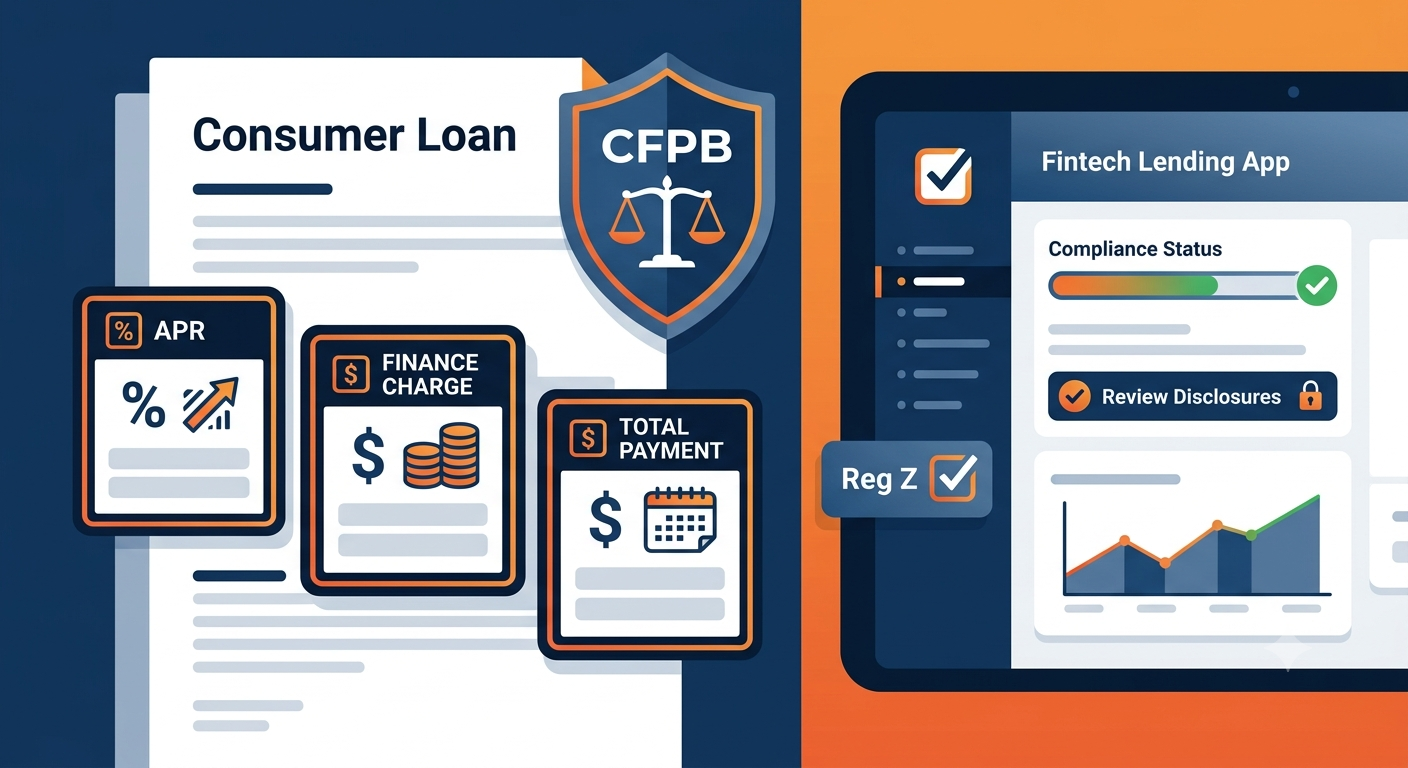
The APR — the cost of credit expressed as a yearly rate — is the most important disclosure required by Regulation Z. The APR must be calculated using a standardized method that captures the full cost of the credit (including fees) expressed as an annual rate. The standardized calculation method makes it possible for consumers to compare the true cost of credit across lenders, loan types, and term lengths.
For fintech lenders, the APR calculation must include all charges imposed as a condition of the credit — including origination fees, mandatory insurance premiums, and other required charges — not just the stated interest rate. Advertising an interest rate that is lower than the actual APR without prominently disclosing the APR alongside it is a Regulation Z violation.
Finance Charge Disclosure
The finance charge is the total dollar cost of the credit — the sum of all charges imposed as a condition of the loan over its full term. Regulation Z requires this to be disclosed clearly along with the APR. For consumers evaluating a specific loan, the finance charge tells them the total cost in dollar terms rather than as a percentage.
TILA Disclosure Box
Regulation Z requires a standardized disclosure box — sometimes called the TILA box or Schumer box for credit cards — that presents key credit terms in a standardized format. For closed-end consumer credit (personal loans, installment loans), this includes the APR, finance charge, amount financed, total of payments, and payment schedule. The disclosure must be provided before consummation of the credit transaction — before the consumer is bound by the credit agreement.
Right of Rescission
For certain credit transactions secured by a consumer's principal dwelling — most commonly home equity loans and refinances — Regulation Z provides a three-business-day right of rescission during which the consumer can cancel the transaction without penalty. This right does not apply to purchase mortgage transactions but applies to most other dwelling-secured credit. For most fintech consumer lending products that are not secured by homes, this provision is not directly applicable.
Advertising Requirements
When a fintech advertises consumer credit — in any medium, including digital advertising, website content, and app store listings — Regulation Z requires that if any specific credit term is mentioned, all required terms must be disclosed. Mentioning only the most favorable term (such as a low introductory rate) without the required companion disclosures (such as the full APR) is a Regulation Z violation in advertising.
Regulation Z and BNPL
Buy Now Pay Later products have been a contested regulatory category under Regulation Z. The CFPB issued guidance in 2022 characterizing many BNPL products as credit cards subject to Regulation Z's credit card provisions — which would require credit card disclosures, billing statement requirements, and dispute resolution procedures. The regulatory status of BNPL under Regulation Z remains an active area of regulatory development. Fintech lending license considerations for BNPL products include this regulatory uncertainty.
Regulation Z and Bank Partnerships
For fintechs that originate loans through bank partnerships — where a bank is the lender of record and the fintech operates as a technology platform or servicer — Regulation Z disclosures are typically prepared by the fintech and issued by or on behalf of the bank. The fintech is responsible for ensuring that the disclosures it prepares are Regulation Z compliant. The bank retains ultimate legal responsibility for disclosure compliance, but the fintech's contractual obligations typically include ensuring disclosure accuracy.
Frequently Asked Questions
Does Regulation Z apply to business credit as well as consumer credit?
Regulation Z generally applies to consumer credit — credit extended to individuals for personal, family, or household purposes. Credit extended primarily for business, commercial, or agricultural purposes is generally exempt. A fintech lender that lends to both consumers and small businesses must determine which of its products are consumer credit (and therefore subject to Regulation Z) and which are commercial (and therefore exempt).
What is the difference between Regulation Z and Regulation B?
Regulation Z governs credit disclosures — how the terms of credit are disclosed to consumers. Regulation B implements the Equal Credit Opportunity Act and governs equal access to credit — prohibiting discrimination in credit decisions based on protected characteristics such as race, sex, national origin, and age. Both apply to consumer credit lenders, but they address different aspects of the credit transaction. For fintech lenders, both Regulation Z compliance and Regulation B compliance are required.
Can Regulation Z requirements be waived by the consumer?
No. Regulation Z's protections cannot be waived by agreement with the consumer. A consumer cannot sign away their right to required disclosures. Any provision in a loan agreement purporting to waive Regulation Z requirements is void.
How ComplyOne Helps
ComplyOne helps fintech lenders design Regulation Z compliant disclosure programs — from APR calculation methodology to TILA disclosure box design to advertising review — and build the broader consumer compliance frameworks that consumer credit products require. For companies planning a lending business, our guide on the fintech lending license covers the licensing dimension of this compliance picture.
Talk to the ComplyOne team to get started.
The information in this article is for general educational purposes and does not constitute legal or regulatory advice. Consult qualified legal counsel for Regulation Z guidance specific to your consumer credit products.