A BSA audit is the independent testing requirement built into every BSA/AML compliance program. Here is what a BSA audit involves, who conducts it, what it covers, and how to prepare.
What Is a BSA Audit? A Guide for Fintechs
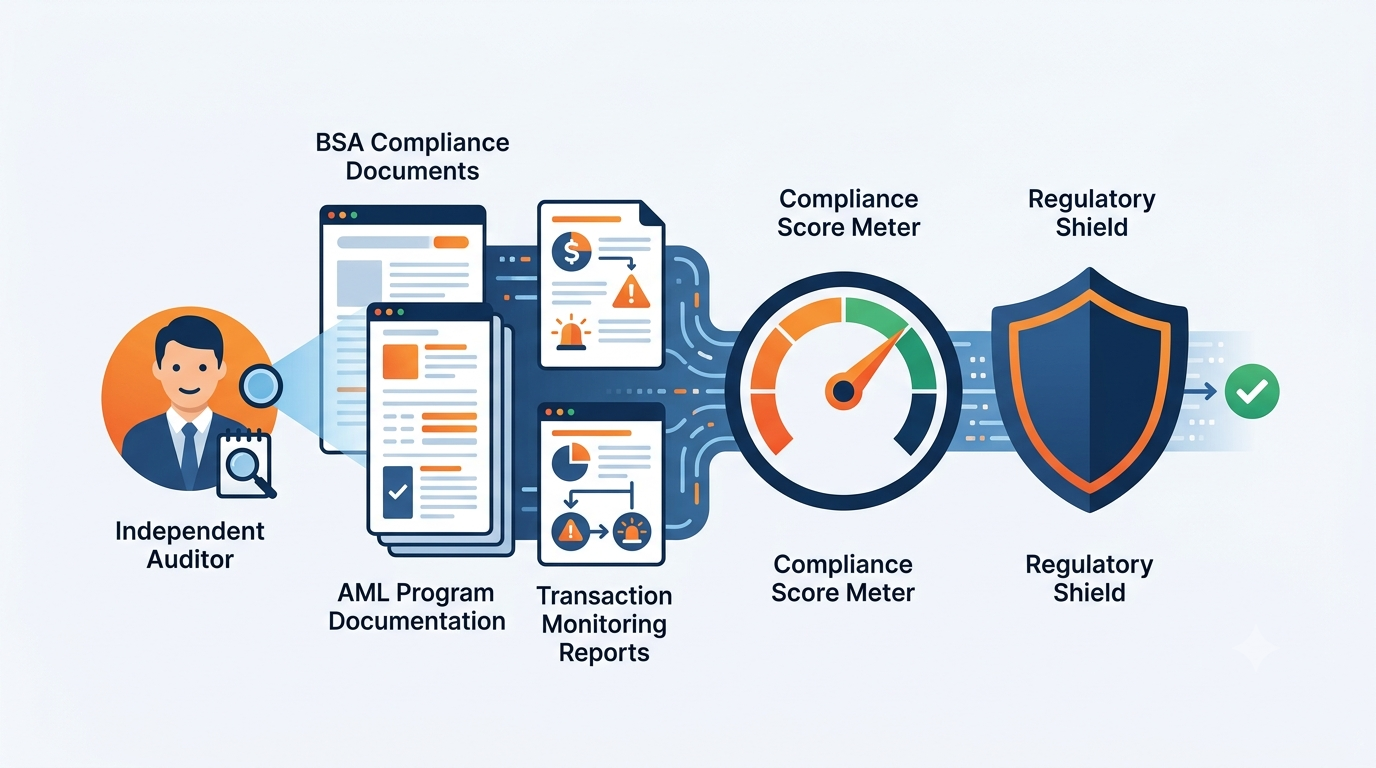
A BSA audit — also called an independent BSA/AML compliance review or independent testing — is a required component of every Bank Secrecy Act compliance program. It is the mechanism through which your compliance program is tested by someone outside the day-to-day compliance function to assess whether the program is working as designed and whether it meets regulatory requirements.
For fintechs, the BSA audit is often the component of the BSA/AML compliance program that receives the least attention during program build — and that causes the most problems when it is missing or deficient. Understanding what a BSA audit is and how to approach it proactively is important for any fintech operating under the Bank Secrecy Act.
Why Independent Testing Is Required
FinCEN's BSA regulations require that AML programs include "independent testing to test compliance." The word "independent" is meaningful — the testing function must be conducted by someone who is independent of both the individuals responsible for BSA compliance and the business functions being tested.
The rationale is straightforward: a compliance program that is only ever reviewed by the people running it lacks the objectivity needed to identify blind spots, gaps, and deficiencies. Independent testing provides an outside perspective that catches problems the compliance team may be too close to see.
Who Conducts a BSA Audit?
The independence requirement does not specify that testing must be conducted by an outside firm — it requires that testing be conducted by someone independent of the BSA compliance function. For most fintechs, particularly early-stage companies, the most practical approach is to engage an outside compliance consulting or accounting firm that specializes in BSA/AML program audits.
For larger fintechs with internal audit functions, independent testing can be conducted by internal audit if that function reports to the board or audit committee — not to the BSA Compliance Officer or the compliance function. The auditor cannot report to the person responsible for the compliance program being tested.
What a BSA Audit Covers
A thorough BSA audit typically covers the following areas.
Written AML program assessment — reviewing the written compliance program for completeness, accuracy, and adequacy. Does the written program accurately describe your actual compliance activities? Does it address all required program elements? Is it current and updated as your business has evolved?
Customer identification and KYC review — testing a sample of customer accounts to verify that CIP and KYC procedures are being followed. This typically involves reviewing account opening documentation, checking that identity verification was conducted appropriately, and confirming that risk ratings were assigned consistently with policy.
Beneficial ownership review — for business entity customers, testing that beneficial ownership information was collected and verified consistent with policy and the CDD Rule.
Transaction monitoring review — assessing whether the transaction monitoring program is appropriately calibrated, whether alerts are being generated at appropriate rates, whether alert review is documented, and whether high-risk alerts are being escalated appropriately.
Suspicious activity review — testing SAR filing decisions to verify that suspicious activity is being reported as required, and that SAR filings meet quality standards.
OFAC sanctions screening review — assessing whether OFAC sanctions screening is occurring at onboarding and on an ongoing basis, and whether the technical implementation is adequate.
Training review — verifying that required AML training has been completed and documented.
Management reporting — assessing whether the BSA Officer has adequate reporting to management and the board on compliance program performance.
How Often Is a BSA Audit Required?
FinCEN's regulations do not specify a mandatory frequency for independent testing. However, banking regulators have consistently expected annual independent testing for most financial institutions — and sponsor banks universally require annual BSA audits from their fintech program managers as a condition of the relationship.
Higher-risk businesses — those with elevated money laundering risk based on products, customers, or geographies — may be expected to conduct testing more frequently than annually.
What to Do With Audit Findings
The purpose of a BSA audit is not just to get a report — it is to identify and correct deficiencies. When the audit identifies gaps in the compliance program, those findings must be tracked, remediated, and documented. Regulators expect to see that audit findings are addressed, and the failure to remediate identified deficiencies is itself a significant compliance failure.
The audit findings, the management response, and the remediation documentation should all be retained as part of your BSA compliance records.
Frequently Asked Questions
Can a startup fintech delay its first BSA audit?
The BSA does not provide a grace period for BSA audits based on company age or stage. The requirement for independent testing applies from the time a company begins operating as an MSB. As a practical matter, a company needs to have a compliance program in place before it can be audited — but the audit should follow initial compliance program implementation within a reasonable time, typically within the first 12 months of operations.
How much does a BSA audit cost?
The cost of a BSA audit depends on the scope and complexity of the engagement and the firm conducting it. For an early-stage fintech with a limited product scope, a BSA audit from a specialized compliance consulting firm typically ranges from $10,000 to $30,000. For a more complex fintech with multiple product lines, high customer volumes, or complex transaction monitoring, costs can be substantially higher.
What is the difference between a BSA audit and a FinCEN examination?
A BSA audit is an internal compliance function — testing conducted by or on behalf of your company to assess your own program. A FinCEN examination is an external regulatory review conducted by FinCEN or by a delegated examiner (such as IRS for MSBs). Both assess BSA compliance, but the BSA audit is an internal tool while the FinCEN examination is a regulatory process. Having a strong track record of independent testing and remediating findings is important preparation for a FinCEN examination.
How ComplyOne Helps
ComplyOne conducts independent BSA/AML program audits for fintechs — assessing compliance program completeness and effectiveness, identifying gaps and deficiencies, and providing the written reports that FinCEN and sponsor banks require.
Talk to the ComplyOne team to get started.
The information in this article is for general educational purposes and does not constitute legal or regulatory advice. Consult a qualified compliance professional for guidance specific to your situation.