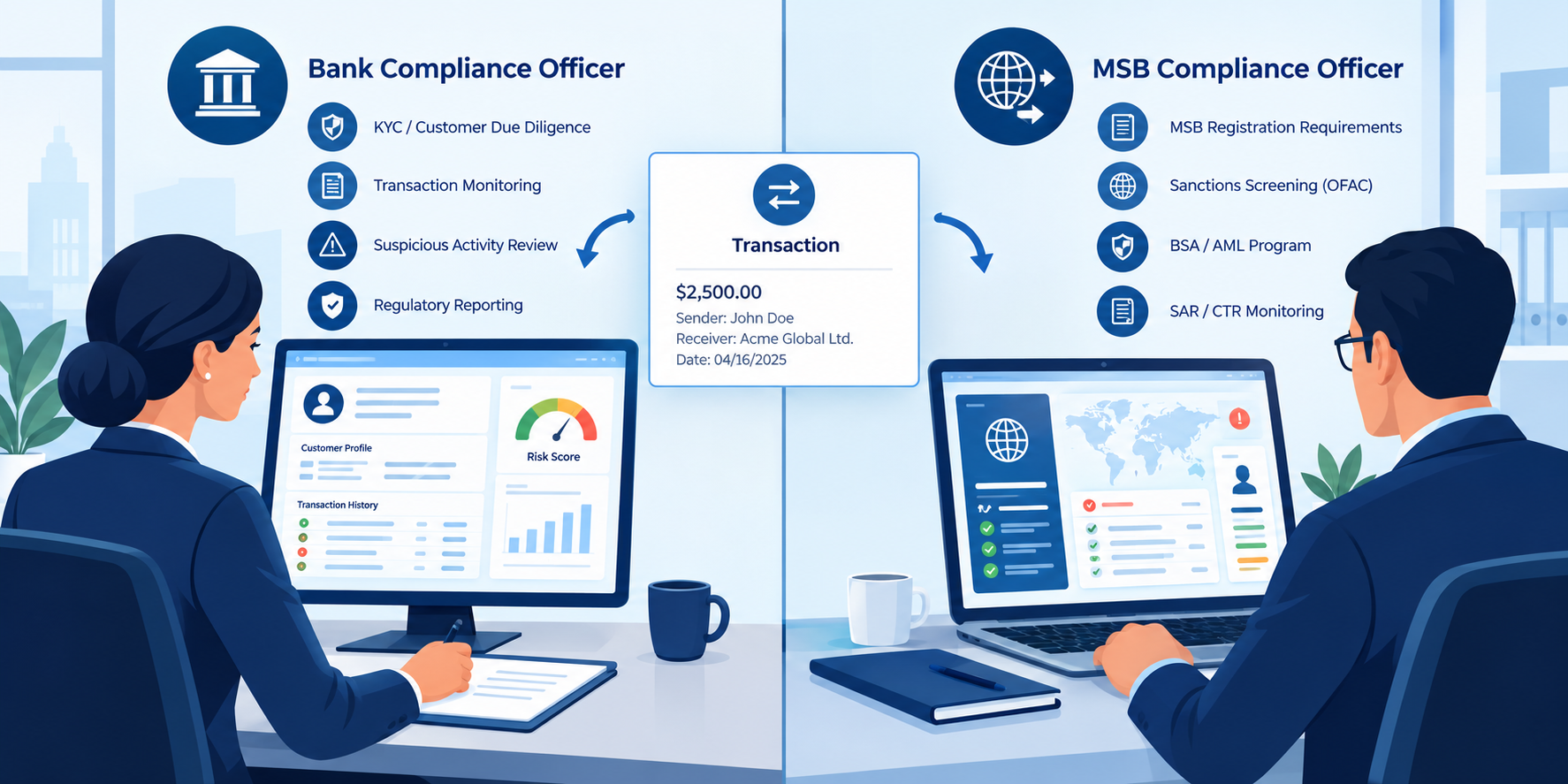
The same payment can look completely different depending on whether you're sitting at the bank or the MSB. A compliance professional who has worked both sides explains why — and what it means for the bank-MSB relationship.
Two Sides of the Same Transaction: A Bank and MSB Compliance Perspective
When we talk about financial transactions, we often discuss banks, Money Services Businesses (MSBs), fintech companies, and payment providers separately. Each operates under its own regulatory requirements, risk appetite, internal procedures, and compliance controls. But in practice, they are often looking at different parts of the same transaction.
Having worked with compliance from both a traditional financial institution perspective and an MSB perspective, I have noticed how differently the same payment can look depending on where you sit.
For an MSB compliance team, a transaction may be perfectly understandable. The customer has completed onboarding, the beneficial owners have been identified, the source of funds has been reviewed, sanctions screening has produced no relevant matches, and the transaction is consistent with the customer's expected activity.
Then the transaction reaches a bank.
The bank does not necessarily see everything the MSB sees. Instead, it sees the movement of funds through the MSB's account: the amount, counterparties, jurisdictions, transaction frequency, and overall patterns of activity. As a result, a transaction that appears straightforward and well understood by the MSB may still raise questions from the bank's perspective.
Neither side is necessarily wrong. They are simply looking at the same transaction through different compliance lenses.
The MSB Side: Who Is My Customer?
Let's start from the MSB's perspective.
Before processing a transaction, an MSB needs to understand its customer. Depending on the customer and the services provided, this can involve KYC or KYB, beneficial ownership identification, sanctions and PEP screening, adverse media checks, customer risk assessment, and understanding the nature and purpose of the relationship.
In simple terms, the MSB is trying to answer:
Do we understand who our customer is, what they are doing, where the money comes from, where it is going, and whether the activity makes sense?
Consider a relatively simple example.
A corporate customer needs to pay a $30,000 commercial invoice. The customer provides the invoice and explains the purpose of the payment. Its ownership structure has already been verified during onboarding. The transaction is consistent with the nature of its business and expected activity. The relevant screening and transaction-monitoring controls do not identify anything requiring the transaction to be stopped. From the MSB's point of view, there may be nothing particularly unusual about the payment.
But this is only one side of the transaction.
The Bank Side: Does This Activity Make Sense for the MSB?
Now let's look at the same transaction from the perspective of the MSB's banking partner.
The bank's customer may not be the underlying company making the $30,000 payment. Its customer is the MSB. That difference is important.
The bank has conducted due diligence on the MSB. It should understand what services the MSB provides, what types of customers it serves, the jurisdictions in which it operates, expected transaction volumes, ownership and management, and the general nature of activity expected through the account.
The bank is therefore asking a slightly different question:
Does the activity we are seeing make sense based on what we know about this MSB?
Suppose the bank sees $30,000 moving through the MSB's account and ultimately going to a third-party beneficiary.
The MSB may know exactly why. It may have the customer's corporate documents, beneficial ownership information, transaction purpose, commercial invoice, and screening results. The bank may have none of that information immediately available.
What the bank does have is its own view of the MSB's account activity. It can see transaction patterns across time, counterparties, jurisdictions, volumes, and deviations from expected behavior.
As a result, something that makes complete sense at the customer level may still create a question at the banking level.
The Information Gap
This is where I believe one of the most interesting challenges in the bank-MSB relationship appears: the information gap.
The MSB may see: "A verified corporate customer is making a legitimate commercial payment that is consistent with its expected activity."
The bank may see: "Our MSB customer is moving $30,000 between parties, potentially involving multiple jurisdictions or payment channels."
These are two descriptions of the same transaction. The difference is context.
The MSB usually has much deeper information about its underlying customer. The bank, on the other hand, has broader visibility into activity occurring through the MSB's bank account and potentially into patterns the MSB cannot see elsewhere in the financial system.
This difference in visibility can lead to requests for information, additional due diligence, delayed transactions, or questions about particular customers or counterparties. From the MSB side, these requests can sometimes feel repetitive — after all, the MSB has already performed customer due diligence. But from the bank's perspective, the questions may be necessary to understand whether the activity remains consistent with the risk profile established for the MSB.
The Same Red Flag Can Mean Something Different
Another interesting point is how red flags are viewed.
Imagine that a customer begins making significantly larger transactions than originally expected.
For the MSB, the first question may be whether the customer's profile has changed. Has the business expanded? Is there a reasonable source of funds? Does the new activity remain consistent with the customer's business model? The MSB may contact the customer, obtain supporting documentation, update the risk assessment, and determine that the activity is reasonable.
The bank may see the same increase differently.
If the MSB previously represented that its expected transaction activity would remain within a certain range, a sudden increase in volume may appear inconsistent with the MSB's expected account profile.
The MSB is monitoring the customer. The bank is monitoring the MSB.
That distinction sounds simple, but it explains a lot of the friction that can occur between the two.
The same applies to geography, transaction velocity, counterparties, and unusual payment patterns. A factor that has already been investigated and reasonably explained by the MSB may still require review by the bank because each institution has independent compliance responsibilities. This is why understanding the complete transaction flow is so important.
Why the Bank-MSB Relationship Matters
MSBs depend heavily on access to the traditional financial system. At the same time, banks need to manage the financial-crime and regulatory risks associated with providing services to MSBs.
Historically, this relationship has sometimes resulted in broad de-risking — where institutions become uncomfortable with a category of customers rather than assessing the actual risks presented by a particular business.
A stronger approach is based on understanding.
For an MSB, this means being able to clearly explain its business model to its banking partners. What types of customers do we serve? What products do we provide? Which jurisdictions do we operate in? What does the transaction flow actually look like? What controls are applied before and after a transaction? How do we manage higher-risk customers? How do we respond when activity changes?
These should not be difficult questions to answer only when a bank sends an urgent request for information. The answers should already form part of the MSB's compliance framework.
For banks, understanding the MSB's actual business model is equally important. Two companies may both be registered as MSBs while having completely different products, customers, transaction flows, and risk exposure. The term "MSB" describes a regulatory category. It does not, by itself, describe the level of risk presented by a particular institution.
Compliance Works Better When We See the Whole Transaction
Working with financial institutions and MSBs has made one point especially clear to me: compliance decisions depend heavily on perspective.
The MSB may have the strongest visibility into the underlying customer. The bank may have broader visibility into the movement of funds through the financial system. Each participant holds a piece of the puzzle. The challenge is making sure those pieces create a consistent picture.
That is why strong compliance is not simply about collecting documents, completing a checklist, or screening a name against a database. It is about understanding the transaction: who is involved, why it is happening, how the funds are moving, what risks exist at each stage, and whether the activity makes sense.
The same $30,000 payment can look very different depending on which side of the transaction you are sitting on. And sometimes the best way to understand the risk is to look at it from both sides.
Shamama Alekperova is a compliance professional with experience across both traditional financial institutions and money services businesses.
Disclaimer: This article reflects the author's professional perspective and is for informational purposes only. It does not constitute legal or compliance advice.
If your MSB is navigating its banking relationships or building out its compliance program, talk to the ComplyOne team to get started.